
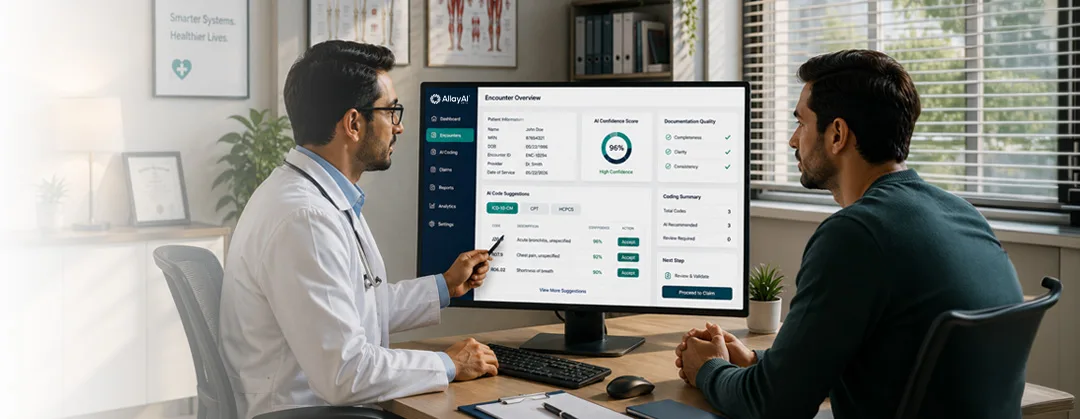
A patient visit may take only a few minutes, but the administrative work behind that encounter can continue long after the patient leaves the exam room.
For physicians, the process often starts with documenting the encounter and continues through coding, claim preparation, and reimbursement. When these steps depend heavily on manual work or disconnected systems, valuable time can be lost moving information from one stage to another.
This is where medical coding software is becoming increasingly important.
Modern AI-powered healthcare technology can help connect clinical documentation with coding workflows, allowing practices to reduce repetitive administrative work and create a more connected path from the patient encounter to the claim.
For U.S. physicians and healthcare practices, the real opportunity isn’t simply replacing manual coding with AI. It’s creating a workflow where accurate clinical information can move efficiently through the coding process while keeping appropriate human oversight in place.
What Is Medical Coding Software?
Medical coding software is technology designed to support the process of translating clinical information from a patient’s encounter into standardized medical codes used in healthcare administration and billing.
Traditionally, this process can require reviewing clinical documentation, identifying relevant diagnoses and procedures, selecting appropriate codes, and preparing information for the next stage of the revenue cycle.
AI is changing how software can assist with these activities.
Instead of treating coding as an isolated task, AI-powered systems can connect coding assistance with the clinical documentation created during the patient encounter.
This creates a more connected workflow:
Patient conversation → Clinical documentation → Coding support → Claims workflow
The important distinction is that AI can assist the workflow without replacing the physician’s clinical judgment or the appropriate review processes.
Why Medical Coding Is Closely Connected to Clinical Documentation
Coding begins with documentation.
If important clinical information isn’t captured clearly in the patient’s record, the coding process becomes more difficult. This is why documentation and coding should not be treated as completely separate activities.
Consider a typical physician encounter.
The physician speaks with the patient, evaluates the situation, records findings, and creates a clinical note. That documentation then becomes an important source of information for coding and downstream administrative workflows.
When documentation and coding operate in disconnected systems, staff may need to review information repeatedly and manually transfer details.
AI can help create a more connected process by allowing coding assistance to work from the clinical documentation generated during the encounter.
For practices, this can mean fewer unnecessary handoffs and a smoother administrative workflow.
How AI Is Changing Medical Coding Software
From Manual Review to AI-Assisted Coding
Traditional coding workflows often depend heavily on manual review.
AI-powered medical coding software can analyze clinical documentation and identify potential coding opportunities based on the information captured in the encounter.
For example, HELIX by AllayAI connects AI-assisted clinical documentation with coding support. Its clinical documentation workflow includes ICD-10 and CPT suggestions, helping connect the information captured during the visit with the coding stage.
The purpose isn’t to make independent clinical decisions. Instead, AI provides assistance that can help healthcare professionals review relevant coding information more efficiently.
Connecting Documentation and Coding
One of the biggest advantages of an integrated approach is continuity.
With HELIX, clinical documentation is not treated as the end of the workflow. The information captured during the encounter can move into the next stages, including AI-powered coding and claims workflows.
This is important because healthcare teams shouldn’t have to repeatedly re-enter information that already exists.
A connected workflow can help reduce unnecessary administrative handoffs while keeping the patient encounter at the center of the process.
What Should Physicians Look for in Medical Coding Software?
Not every coding solution will fit every practice.
When evaluating medical coding software, physicians and healthcare decision-makers should look beyond whether a platform simply offers AI.
Integration With Clinical Documentation
Coding works best when it is connected to the documentation process.
A platform that connects clinical documentation and coding can reduce the need for staff to manually move information between separate workflows.
Support for Standard Coding Systems
Healthcare practices need technology that works with the coding systems relevant to their workflows.
HELIX provides ICD-10 and CPT suggestions as part of its AI-assisted documentation and coding workflow.
Workflow Connectivity
Coding should not exist as an isolated function.
The strongest approach connects documentation, coding, claims, and other relevant administrative processes so information can move through the workflow without unnecessary duplication.
Human Oversight
AI should support healthcare professionals rather than remove appropriate review and decision-making from the process.
Coding technology should therefore be used as an assistance layer within a controlled healthcare workflow.
How AI Medical Coding Software Can Support Healthcare Practices
For physicians, the value of AI coding technology goes beyond generating potential codes.
The larger opportunity is reducing the administrative friction surrounding each patient encounter.
When clinical documentation, coding, and claims workflows are connected, practices can create a smoother path from the exam room to reimbursement.
This can help teams spend less time searching through documentation, moving information between systems, and repeating administrative tasks.
For a busy private practice, even small workflow improvements can make the overall day feel more manageable.
Instead of asking staff to repeatedly move information from one stage to another, an integrated platform can help carry the encounter forward.
Medical Coding Software and the Future of Connected Healthcare Workflows
AI is increasingly being used across healthcare workflows, but its greatest value may come from connecting processes rather than automating isolated tasks.
This is the approach behind HELIX.
The platform connects the patient encounter across several stages, beginning with clinical documentation and continuing through workflow automation, real-time translation, patient context, coding, and claims.
Medical coding therefore becomes part of a broader healthcare workflow rather than a standalone administrative activity.
For physicians, this distinction matters.
The goal isn’t simply to introduce another software tool. The goal is to reduce fragmentation across the workflow.
Why Integrated Coding Matters for Physicians
Physicians already manage complex clinical responsibilities.
Adding more disconnected software can create another layer of administrative work.
An integrated approach allows coding assistance to exist within the same environment as clinical documentation and other workflow processes.
This can help create a simpler experience for healthcare teams.
Instead of:
Document → Switch systems → Review information → Code → Move information again
the goal is a more connected workflow:
Encounter → Documentation → Coding support → Claims
That difference is at the heart of modern healthcare automation.
What Medical Coding Software Means for Modern Practices
The future of coding isn’t simply about faster code selection.
It’s about creating a healthcare workflow where information remains connected from the moment the patient speaks with the physician through the administrative processes that follow.
AI-powered medical coding software can become an important part of that transition by connecting clinical documentation with coding and claims workflows.
For U.S. physicians and healthcare practices evaluating AI technology in 2026, the most useful question isn’t simply:
“Does this software use AI?”
A better question is:
“Does this technology make the entire workflow more connected and easier for my team to manage?”
That is where integrated healthcare AI can provide meaningful value.
Frequently Asked Questions
What is medical coding software?
Medical coding software helps healthcare organizations support the process of translating clinical documentation into standardized medical codes. AI-powered solutions can analyze documentation and provide coding suggestions while keeping appropriate professional review within the workflow.
How does AI medical coding software work?
AI medical coding software can analyze information contained in clinical documentation and identify potential ICD-10 or CPT coding suggestions. In HELIX, AI-assisted documentation and coding are connected within the broader patient workflow.
Can AI replace medical coders?
AI should be viewed as a support technology rather than an automatic replacement for professional oversight. Coding workflows can benefit from AI-generated suggestions while qualified professionals remain responsible for appropriate review and decisions.
How does HELIX support medical coding?
HELIX connects AI-assisted clinical documentation with coding and claims workflows. Its documentation process includes ICD-10 and CPT suggestions, helping carry information from the patient encounter into subsequent administrative stages.
Conclusion
Medical coding software is evolving from a standalone administrative tool into an important part of connected healthcare workflows.
AI can help practices connect clinical documentation with coding and claims, reduce repetitive administrative steps, and create a smoother path from the patient encounter to reimbursement.
For physicians, the goal should not be to add more technology for technology’s sake. It should be to use technology that genuinely simplifies the work surrounding patient care.
With HELIX, AllayAI takes an integrated approach—connecting clinical documentation, workflow automation, patient communication, coding, and claims within one healthcare AI platform.
When every step of the healthcare workflow is connected, coding becomes more than an administrative task. It becomes part of a smarter, more efficient patient journey.